Welcome back to our Marketing My Pharmacy series, where we look at practical ways to market your business, reach new patients, and strengthen relationships with the people you already serve.
We have talked about social media, community presence, in-store marketing, and why your pharmacy needs a strong website. Those channels help you share what your pharmacy offers, but effective marketing begins before you create a post, sign, or campaign. It begins with understanding what your patients need.
Patients do not always walk in and clearly explain the problem. They may call to ask whether a refill is ready, delay picking up a prescription, or mention that they have been busy. The surface-level question may sound routine, but it can point to a larger challenge involving access, affordability, transportation, or medication management.
Your team probably knows what to do when a patient directly asks for help. The greater opportunity is learning how to recognize the signals, ask the right follow-up questions, and connect the patient with a useful solution before they have to spell out the problem.
Continue Reading
Explore more pharmacy marketing strategies:
Continue Reading
Explore more pharmacy marketing strategies:
Ask Before You Promote
Marketing is not only telling patients what your pharmacy offers. It is helping them recognize that a product or service may solve a problem they have been managing on their own.
Instead of waiting for a patient to request a specific service, listen for moments that invite one more question:
- A patient calls about a refill that is out of renewals.
- A prescription has been returned to stock or remains unclaimed.
- A patient repeatedly asks when several prescriptions will be ready.
- A patient mentions work, caregiving, transportation, or scheduling challenges.
The goal is not to turn every interaction into a sales pitch. It is to notice when a routine question may be connected to a bigger need and give the patient room to tell you more.
A useful follow-up question is specific to what is already happening. If a patient is on the last refill, ask whether the next appointment is scheduled. If a prescription has remained in will-call, ask whether getting to the pharmacy has been difficult. If several medications are due on different dates, ask whether coordinating them would make life easier.
These questions help your team uncover the problem first. Once the need is clear, the service becomes a relevant solution rather than another offer the patient did not ask for.
That shift changes the conversation from “Here is what we offer” to “Here is how we may be able to help.”
Telehealth: Notice the Gap Before the Patient Asks

Consider a patient who calls about a refill, but the prescription has no renewals remaining. The easy response is to say that the pharmacy is waiting to hear from the prescriber. A better response is to ask, “Do you already have your next appointment scheduled?”
That question may reveal that the patient cannot get an appointment for several weeks, has changed providers, or does not know where to begin. Now your team understands the barrier and can explain any appropriate care-access options the pharmacy offers, including telehealth.
The service matters because your team uncovered the access problem first. Without the follow-up question, the conversation may have ended with “We are still waiting on your doctor.”
When you promote telehealth online or inside the pharmacy, use that same problem-first approach. Focus on the moments when patients may need another path to care, then explain how to ask your team for help.
For example:
“Waiting weeks for an appointment? Ask our pharmacy team about other ways to connect with care.”
The marketing creates awareness, but the follow-up question helps your team connect the right patient with the right solution.
Prescription Savings: Look Beyond the Price Reaction
When a patient openly reacts to a high price, your team likely knows to check available options. The harder need to uncover is the one the patient does not say out loud.
Watch for quieter signals. A patient may ask you to put the prescription back, say they will pick it up later, request only part of the order, or repeatedly ask whether the medication is necessary. Those moments may point to an affordability concern.
Instead of ending the interaction, ask a respectful follow-up question such as, “Is the cost making it difficult to fill this today?” If the patient says yes, your team can explore appropriate savings options or discuss the next step.
When promoting prescription savings, the message should make it easier for patients to begin that conversation before they decide to leave or abandon the prescription.
Instead, try something like:
“Concerned about prescription costs? Talk with our pharmacy team before deciding what to do next.”
This does not promise a lower price. It tells patients that cost is a conversation they can have with your team.
Use the message on your website, social media, bag stuffers, counter cards, or signage. Then make sure your staff knows what signals to notice and what questions they can comfortably ask.
Medication Delivery: Listen for Convenience Barriers

Most patients will not call and say, “I have a transportation barrier.” They may ask whether the pharmacy can hold a prescription for another day, mention that they are waiting for a family member, or repeatedly miss pickup reminders.
Those are opportunities to ask, “Would delivery make it easier for you to receive your medication?” The answer may reveal a need involving transportation, mobility, work schedules, illness, or caregiving.
Once the need is clear, you can explain how your delivery service works, including the service area, eligibility, timing, and potential fees.
The same principle applies to your marketing. “We Deliver” names the service, but it does not help patients recognize when they may need it.
“Having trouble making it to the pharmacy? Ask whether medication delivery could make pickup easier.”
Now the message speaks to the barrier, not just the service.
Your team’s questions and your public-facing marketing should reinforce each other. One creates awareness, while the other helps uncover who may benefit.
Use Marketing to Support Better Conversations
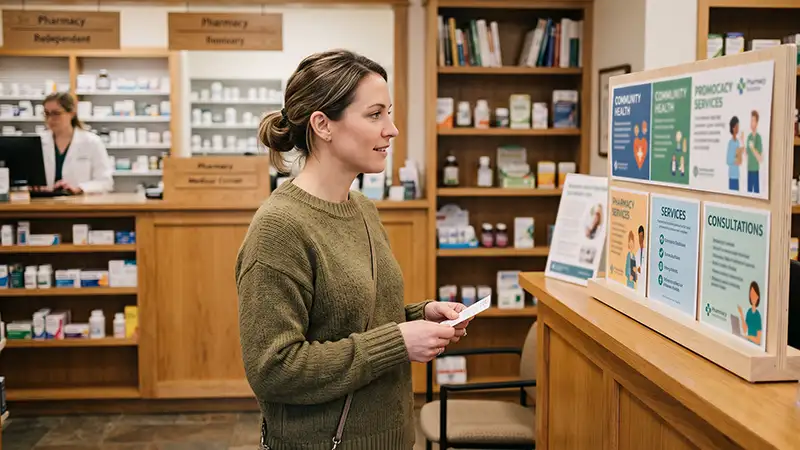
Your website, social media, digital displays, counter cards, bag stuffers, and signage can introduce patients to what your pharmacy offers. However, those materials work best when they prepare patients and staff for a conversation.
A patient may see a delivery message and realize transportation has become a problem. A caregiver may notice medication synchronization on a screen and recognize that coordinating refill dates could help. Good marketing gives patients language for a need they may not have known how to describe.
Choose products and services that address problems your team regularly observes. These may include:
Common opportunities:
- Vaccinations
- Medication delivery
- Telehealth
- Prescription savings
- Medication synchronization
- Health screenings
- Seasonal products
- Community events
- New pharmacy services
Do not place every service on one sign or ask staff to mention everything during every interaction. Choose one recurring patient problem and build a focused message around the solution.
Keep the message simple: name the problem, introduce the possibility of help, and provide one next step.
“Refills landing on different days? Ask whether medication synchronization could simplify your routine.”
The message helps the patient recognize the challenge. Your team’s follow-up questions help determine whether the service is a good fit.
Build Discovery Into Everyday Interactions
This approach should not feel scripted or forced. Start with one service and identify the patient behaviors or routine questions that may signal a related need.
For each service, ask:
- What patient behavior or routine question might signal this need?
- What follow-up question could help us learn more?
- Which product, program, or service could address the problem?
- How can we explain the solution without making the conversation feel like a sales pitch?
- Where can our marketing reinforce the same message?
For example, if you want more patients to use delivery, do not begin with a month of “We Deliver” posts. First, identify the moments when the service may be relevant: an unclaimed prescription, a patient waiting for a ride, or someone repeatedly asking for more time to pick up an order. Give staff one natural question they can use, then reinforce the same problem-focused message on your website and in-store materials.
Now your marketing and patient conversations are working together. One helps patients see what is possible, while the other helps your team uncover who may benefit.
Track the Questions, Not Just the Clicks
Clicks, QR code scans, and social engagement can show whether people noticed the message. To understand whether it is helping patients, also track what happens in the pharmacy.
Ask staff to note which follow-up questions lead to a useful conversation, what barriers patients mention, and which services generate interest. A simple weekly tally is enough to show patterns.
If no one responds, do not assume the service has no value. The message may be too broad, the question may feel unnatural, or the team may be waiting for patients to raise the need first.
Use short staff huddles to review what the team is hearing and refine the approach. Helpful questions include:
- What signals are patients giving us?
- Which follow-up questions are starting useful conversations?
- Which products or services are patients asking about after we explain the problem they solve?
The best wording is not the most polished. It is the question your team can ask naturally and respectfully in a real patient interaction.
Keep listening, adjust the questions, and use what you learn to improve both the patient experience and your marketing.
The Bottom Line
Your pharmacy does not simply offer products and services. It helps patients solve problems involving access, affordability, convenience, and medication management.
The opportunity is not waiting until patients clearly tell you what they need. It is recognizing the signals, asking one thoughtful follow-up question, and understanding the problem before offering a solution.
Start with one service. Identify the moments that may point to a need, give your team a natural question to ask, and create marketing that helps patients recognize when the service could be useful.
When you uncover the problem first, your pharmacy’s value becomes easier for patients to see.
Ready to Explore Your Options?
If these conversations reveal needs your pharmacy is not currently equipped to address, IPC members can explore solutions supporting telehealth, prescription savings, medication delivery, and in-store engagement.
Begin with the patient’s challenge, then find the right solution to help address it.
Continue Reading
Explore more pharmacy marketing strategies: