
In our last installment of Marketing My Pharmacy, we discussed why every independent pharmacy needs a website. Your website builds trust, answers patient questions, and helps people discover your pharmacy online.
But having a website is only half the battle.
What you write on your website is just as important as having one in the first place. Today, patients don’t just search Google for a pharmacy. They ask questions. Increasingly, they ask AI-powered tools questions too. That means your website content needs to be written not only for people, but also in a way that search engines and AI tools can easily understand.
The good news? You don’t need to be a professional writer or marketing expert to create effective website content.
Let’s look at a few practical ways you can improve your website copy using Search Engine Optimization (SEO) and Answer Engine Optimization (AEO) principles.
Continue Reading
Explore more pharmacy marketing strategies:
SEO vs. AEO: What’s the Difference?

Think of it this way:
SEO (Search Engine Optimization) helps your website show up when someone searches for something.
Examples:
- Independent pharmacy near me
- Flu shots near me
- Prescription delivery
AEO (Answer Engine Optimization) helps your website provide direct answers when someone asks a question.
Examples:
- What pharmacies offer prescription delivery near me?
- What services do independent pharmacies provide?
- Who offers weight management programs near me?
SEO helps people find you.
AEO helps you become the answer.
The best websites do both.
Stop Writing About Your Pharmacy. Start Writing for Your Patients.
One of the biggest mistakes businesses make is filling their websites with information about themselves. Patients care less about your history and more about how you can help solve their problems.
Whenever you write website content, ask yourself:
“How does this help my patient?”
Then write the answer.
Create a Page for Every Service
Many pharmacy websites make the mistake of listing all their services on one page.
That creates two problems:
- Patients have difficulty finding specific information.
- Search engines struggle to understand what your pharmacy offers.
Instead, create dedicated pages for each major service.
Each page should explain:
- What the service is.
- Who benefits from it.
- Why it matters.
- How patients can get started.
The more clearly you explain your services, the easier it becomes for patients to find them online.
Answer Real Questions
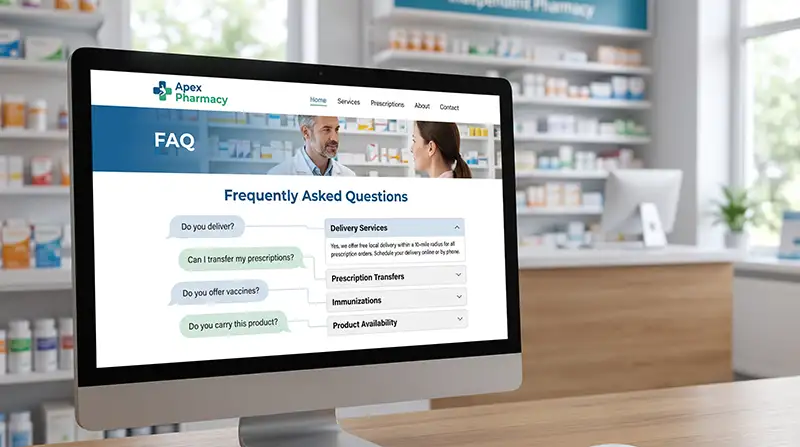
AEO is about answering questions. Think about the phone calls your staff receives every day.
You probably hear questions like:
- Do you deliver?
- Can I transfer prescriptions?
- Do you offer vaccines?
- Can you help with weight management?
- Do you carry this product?
Those questions should be answered on your website.
One of the easiest ways to improve both SEO and AEO is to create an FAQ section.
For example:
Do you offer prescription delivery?
Yes. Our pharmacy offers local prescription delivery to help patients receive their medications without making an extra trip.
Notice how direct this answer is. That’s exactly what search engines and AI tools want to see.
Use the Words Your Patients Use
Healthcare professionals often use terminology that patients would never search for. Write using the language your patients actually use, not the language pharmacists and staff use internally.
A simple exercise:
Ask a family member who doesn’t work in healthcare how they would search for one of your services. Their answer is usually closer to what your patients are typing into Google.
Make Your Content Easy to Scan
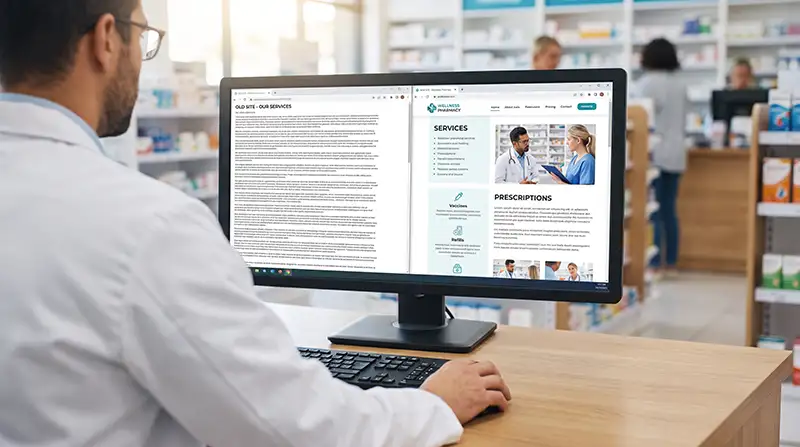
Most website visitors don’t read every word.
They scan.
That means your content should be easy to consume quickly.
Follow these simple guidelines:
Use clear headings.
Good: Prescription Delivery Services
Bad: Helping Our Community Through Convenient Medication Access Solutions
Keep paragraphs short.
Aim for two to four sentences. Large blocks of text often get skipped.
Use bullet points.
Bullets make information easier to find and understand.
Highlight important information.
Help readers quickly identify:
- Benefits
- Services
- Contact information.
- Next steps
A well-organized page improves the experience for both visitors and search engines.
Don’t Forget Local Search
Most independent pharmacies serve a specific geographic area.
That’s why location matters.
Include references to:
- Your city
- Neighboring communities
- Counties you serve
For example:
Our pharmacy proudly serves patients in Madison, Sun Prairie, Waunakee, and surrounding communities. This helps search engines connect your pharmacy with local searches. It also reassures potential patients that you’re nearby and accessible.
Let AI Help, But Don’t Let It Replace You
AI tools can help generate ideas, outlines, and first drafts. They can save time and help overcome writer’s block. However, AI doesn’t know your patients, your community, or your pharmacy. Think of AI as a writing assistant, not the final author. Your experience is what makes the content valuable.
The Bottom Line
Your website isn’t just a digital brochure anymore. It’s one of the most important tools patients use to find, evaluate, and choose your pharmacy.
The best website content focuses on answering patient questions, explaining benefits clearly, and making it easy for search engines and AI tools to understand what your pharmacy offers.
As you review your website, focus on these five priorities:
- Create dedicated pages for major services.
- Answer common patient questions.
- Write using patient-friendly language.
- Organize content with headings and bullets.
- Include local information whenever possible.
Remember, your goal is not to impress Google or AI. Your goal is to help patients find answers. When you do that well, SEO and AEO become a natural byproduct, and your website works harder to help patients find, trust, and choose your pharmacy.
Continue Reading
Explore more pharmacy marketing strategies: